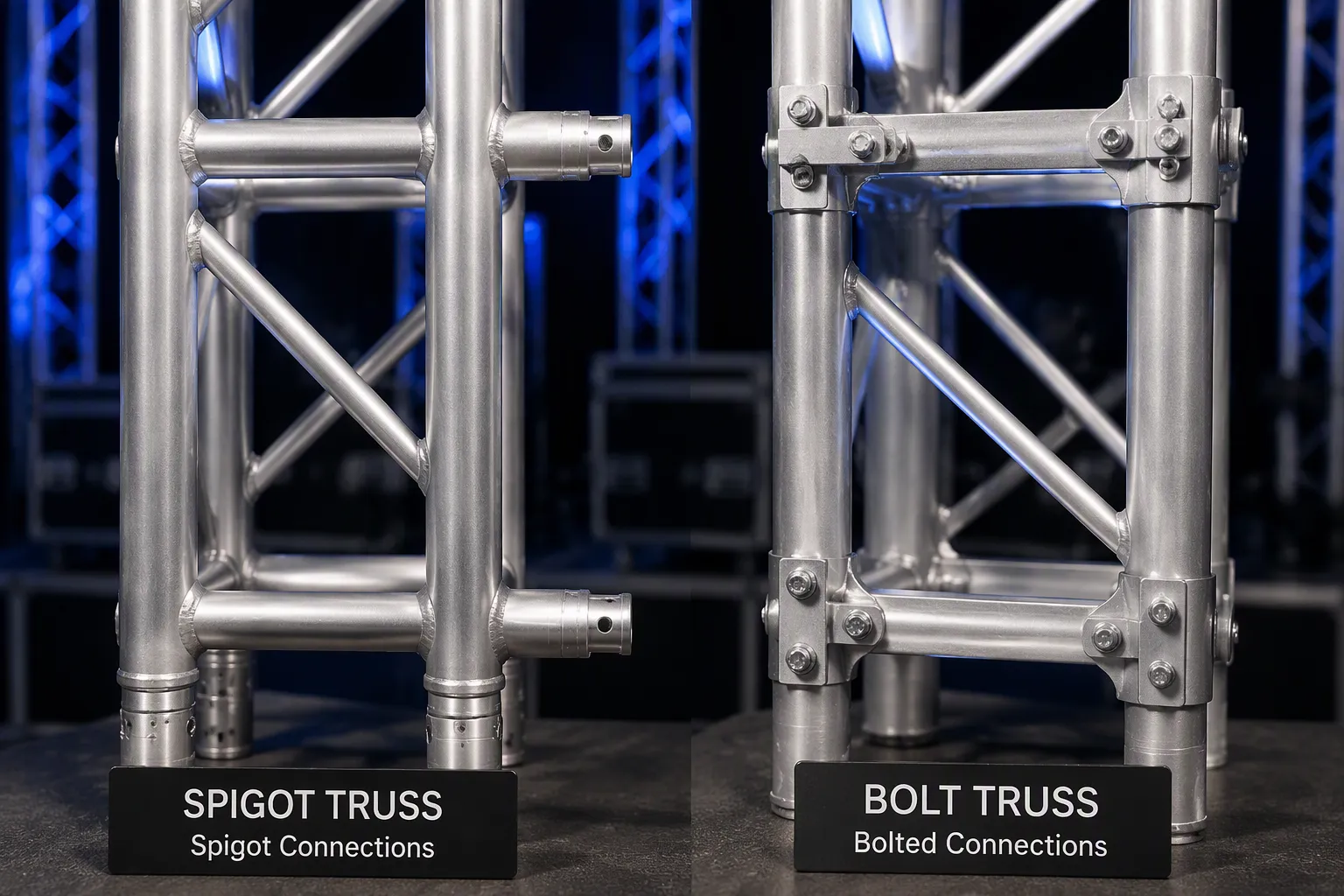
You face a critical choice when planning any stage or exhibition structure: spigot truss or bolt truss. The connection method—internal conical spigots versus traditional bolts—drives assembly speed, structural strength, and cost. New industry insights reveal that spigot trusses assemble faster but bolted trusses perform stronger under heavy loads, clarifying common misconceptions. This article delivers a clear, side-by-side comparison to guide your project-specific decision.
Key Takeaways
-
Spigot trusses assemble faster and handle heavy loads better than bolt trusses.
-
Bolt trusses cost less and work well for permanent, light-load installations.
-
Choose spigot for touring and heavy rigging; choose bolt for fixed setups and tight budgets.
Spigot Truss and Bolt Truss Connection Methods
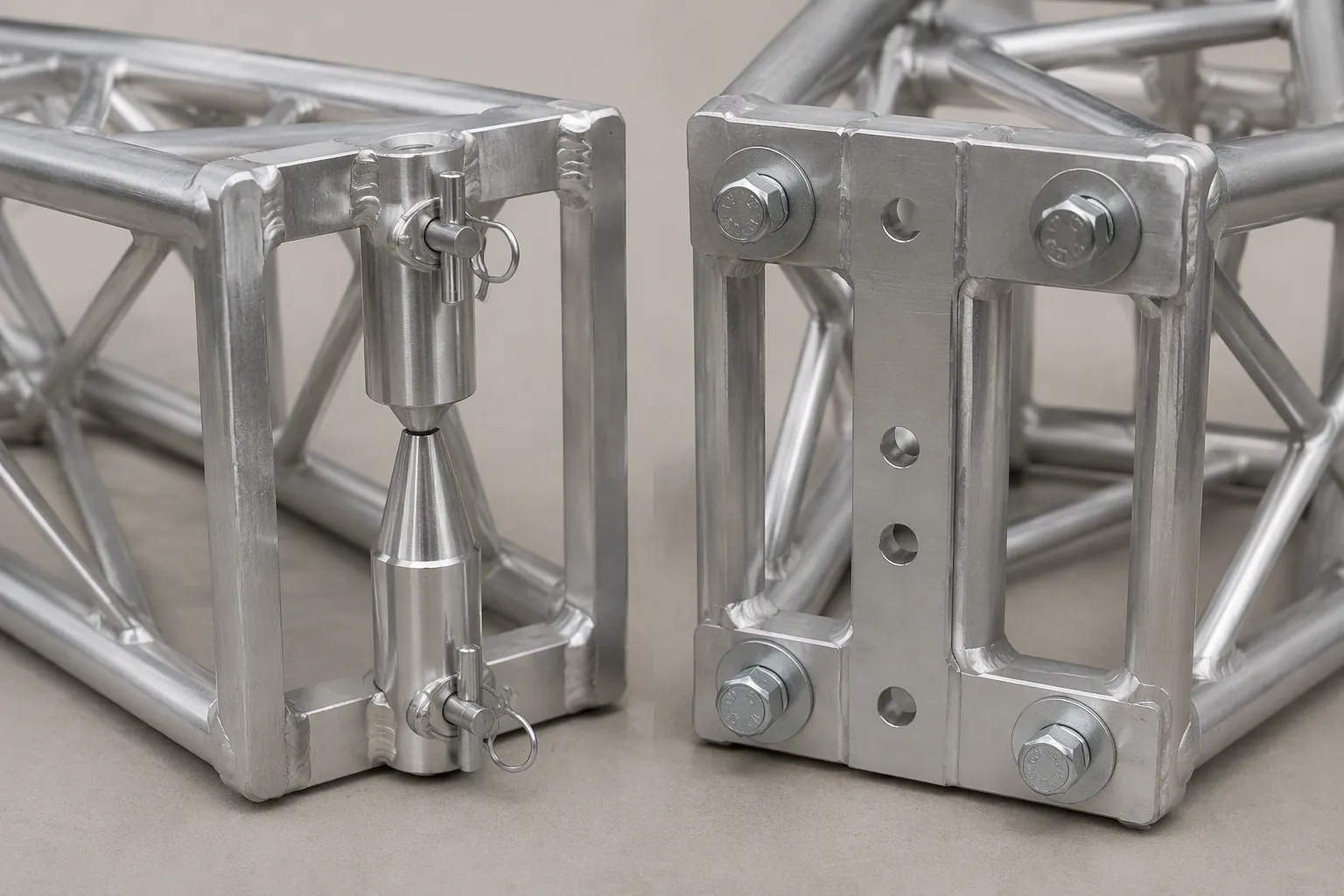
The fundamental difference between these two truss types lies in how individual sections join together. Each connection method influences your assembly workflow, structural behavior, and long-term operating costs. The table below summarizes the core distinctions.
|
Aspect |
Internal Conical Spigot |
Traditional Bolted |
|---|---|---|
|
Hardware |
Spigot, connection pins, retaining clips |
Bolts, nuts, washers |
|
Assembly steps |
Insert spigot, secure with pins |
Align holes, insert bolts, tighten |
|
Installation speed |
Fast; no multiple bolts to tighten |
Slower; requires tools and tightening |
|
Appearance |
Clean; hardware integrates into design |
Visible bolts extend from connection plates |
|
Relative cost |
Higher initial purchase, lower labor |
Lower purchase, higher labor |
Internal Conical Spigot Design
A Spigot Truss employs a male conical connector that fits into a female receiver at the end of each truss section. You slide the sections together, then secure them with connection pins and retaining clips. No tools are required for tightening multiple fasteners. This design reduces setup time dramatically compared to bolted alternatives.
Beyond speed, the spigot connection produces a cleaner appearance. The hardware integrates into the truss profile rather than protruding from connection plates. While the initial purchase price is higher, you recover that investment through lower labor costs and faster turnaround times. The connection method alone does not determine load capacity; factors like wall thickness, material grade, and span length play equally important roles in overall structural performance.
Traditional Bolted Connections
Bolted connections use nuts and bolts to join truss sections. You align the bolt holes, insert each bolt, and tighten it to specification. For a 5/8-inch Grade 8 bolt on lightweight aluminum 12-inch by 12-inch box truss, the standard torque is 80 foot-pounds. This process requires tools and significantly more time per connection than a spigot assembly.
Bolt-through connections ensure greater load transfer efficiency and minimize flex when compared to spigot or coupler-based trusses.
Bolted plate trusses are chosen for permanent installations where higher structural rigidity is necessary. They suit projects demanding precise mechanical connections and support for heavy equipment. The visible hardware and longer assembly time are acceptable trade-offs in applications where you will not frequently dismantle the structure. Manufacturing cost remains lower because the components do not require the same machining precision as conical spigots, making bolted systems a budget-friendly option for fixed setups.
Assembly Speed: Spigot vs Bolt Systems
Rapid Setup with Spigot Connections
A Spigot Truss uses conical connectors, pins, and retaining clips. These components enable quick alignment and reliable connection repeatability across modular sections. The design incorporates self-aligning elements and positive locking mechanisms that ensure proper connection every time. You slide sections together and secure them with pins. No tools are required for tightening multiple fasteners.
Setup time is where spigot truss usually pulls ahead. The sections align faster, require fewer tools, and reduce repetitive bolt handling during long builds. That advantage becomes visible on touring schedules, overnight installs, festival rotations, and projects with multiple flown display elements. A 20-inch spigot truss provides faster assembly for productions prioritizing setup speed. This makes spigot truss vs bolt truss a critical decision for tight timelines.
Time Requirements for Bolt Assembly
Bolt truss uses plates and bolted joints. While it can perform well, assembly is often slower and more exposed to uneven tightening or fit-up delays. Every extra fastening step multiplies across dozens of connections, especially in weather, low light, or crowded loading zones. You must align holes, insert bolts, and tighten each one to specification.
Several factors slow down bolt assembly on-site:
-
Poor node detailing creates bolt conflicts and unclear gusset plates.
-
Connection fit-up difficulties force workers to ream holes or perform unplanned welding.
-
Wind and site access constraints complicate lifting and crane positioning.
-
Temporary bracing needs add delays while crews install and later remove supports.
-
Erection sequencing issues can cause temporary instability and require rework.
-
Connection complexity increases site coordination time with many inspection points.
-
Fabrication and transport errors create major fit-up problems on site.
Understanding these truss connection types helps you plan realistic schedules. Proper aluminum truss connection selection depends on your rigging requirements, load calculations, and assembly timeline.
Load Capacity: Spigot Truss vs Bolt Truss
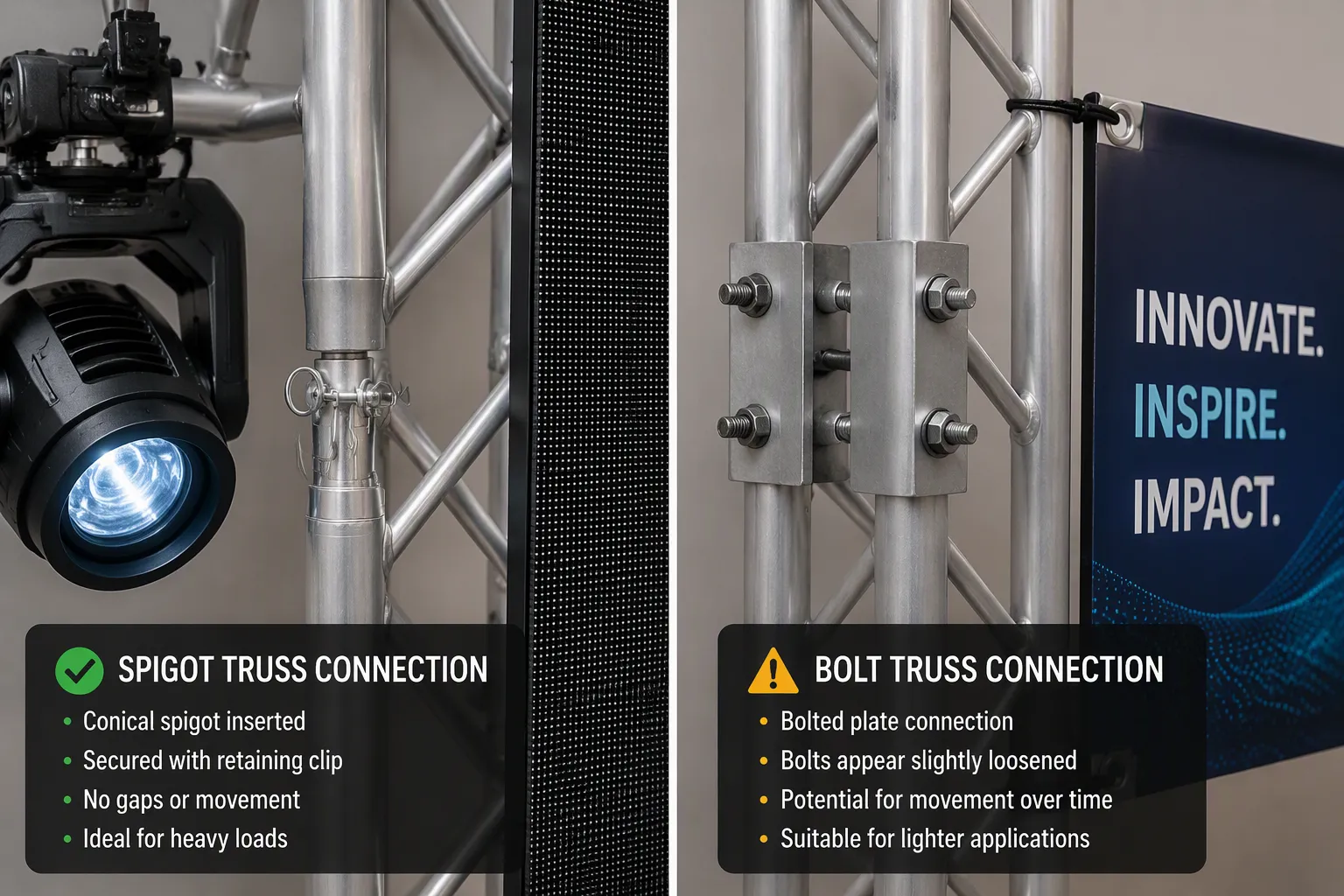
Load capacity is where common assumptions about these two systems often fall apart. Many professionals assume that bolted connections, with their visible hardware and mechanical tightening, must be stronger than a pin-based system, and that assumption holds true. The connection method directly influences how loads transfer through the structure, and the results confirm that bolted trusses offer superior strength.
Superior Strength for Heavy-Duty Loads
A bolt truss outperforms a spigot truss under heavy loads. Box truss (bolt truss) wins on raw load capacity; its four-chord square profile spreads weight across multiple tubes. Bolted truss systems are selected when higher structural rigidity is required. For heavy-duty stage construction or large-span structures, bolt trusses are the superior choice in terms of structural integrity. Spigot trusses handle lighter rigs well, for example a 250kg lighting stage setup rated for 300kg.
Sufficient Performance for Light Loads
Spigot trusses perform well for lighter applications. For a small trade show display, a retail exhibit, or a fixed installation with modest loads, a spigot connection provides adequate strength. The spigot design handles static loads without issue. You can assemble these structures faster because you slide sections together and secure with pins. However, the assembly speed advantage of spigot trusses only applies when the load is light and the structure is simple.
Understanding these truss connection types helps you match the right system to your load requirements. Proper aluminum truss connection selection depends on your rigging plan, span length, and expected dynamic forces. Always verify load ratings with your supplier before finalizing your design.
Ideal Applications for Each Truss Type
Your application dictates which system you should choose. The decision matrix below maps common project types to the better-suited truss.
|
Project Type |
Recommended Truss |
Primary Reason |
|---|---|---|
|
Concerts and touring |
Spigot |
Fast setup and teardown |
|
Trade shows and exhibitions |
Spigot |
Quick assembly, clean look |
|
Heavy roofs and long spans |
Bolt |
Superior structural integrity |
|
Permanent installations |
Bolt |
Lower cost, rigid fixed joints |
|
Budget-constrained displays |
Bolt |
Lower purchase price |
Event and Touring Use Cases
Touring productions demand speed above all else. You load in overnight, build the rig, run the show, and strike before dawn. A Spigot Truss fits this rhythm perfectly. Its connectors fit together easily with minimal tools and manpower. You slide sections together and secure them with pins. No wrench, no torque specification, no repetitive bolt handling.
Trade shows and exhibitions share this need for frequent setup and dismantling. You may build and tear down the same booth a dozen times in a season. Spigot connections reduce that labor dramatically. The streamlined appearance also helps here. No visible bolts or connectors interrupt the clean lines of your display, which matters when the structure itself is part of the visual design.
Concerts and large stage setups also favor spigot systems for their speed and convenience. When you compare spigot truss vs bolt truss for a touring rig, the assembly speed of the spigot design usually decides the question.
Permanent Installation Use Cases
Fixed installations follow different logic. You build the structure once and leave it in place for years. Assembly speed matters far less than purchase cost and long-term rigidity. Bolt trusses serve this niche well. They cost less because the components do not require the same machining precision as conical spigots. The bolted plate joint also provides a rigid, permanent connection that suits heavy roofs and long spans in venues, studios, and architectural features.
Budget-constrained projects often land here too. A retail display or a small exhibit with modest loads does not need the precision of a spigot system. A bolted connection provides adequate strength at a lower price point. You accept slower installation because you install it once.
Understanding truss connection types helps you match hardware to context. Proper aluminum truss connection selection depends on how often you build, how much weight you fly, and how much you can spend. Weigh those three factors before you commit.
Cost and Manufacturing Differences
Manufacturing Complexity and Cost
Bolt trusses cost less to manufacture. They do not require the same high precision as spigot connectors. The conical spigot design demands tight tolerances on the tapered surfaces and high-quality steel pins. This machining complexity drives up production expense. Brands such as GF-Truss offer quality options in both categories. Pricing varies widely based on specifications and supplier, with spigot systems typically costing more due to precision machining.
Long-Term Value Considerations
Your total cost of ownership must account for more than the purchase price. Conical couplers require more precise machining and higher-quality steel pins, but they significantly reduce labor costs during assembly. A bolt system may cost less to buy. A spigot system may cost less to operate over many projects if labor is a significant factor.
For aluminum truss structures events teams move city to city, labor savings can offset higher purchase costs over time.
For larger spans, repeated deployments, and heavy suspended equipment, bolt truss is usually the stronger operational choice. Consider maintenance requirements—spigot joints may require periodic attention depending on usage, while bolt systems may need inspection of hardware. The overall value depends on usage intensity and project needs.
Spigot Truss wins on speed; Bolt truss wins on strength and cost-effectiveness for lighter projects. The connection method defines your choice.
|
Choose |
When |
|---|---|
|
Spigot |
Touring, light to moderate rigging, frequent staging |
|
Bolt |
Fixed installs, tight budgets, heavy loads |
Weigh your load, timeline, and budget. Consult trusted suppliers for specifications.
FAQ
What is the main difference between spigot and bolt trusses?
The connection method defines both systems. Truss connection types differ: spigot uses conical connectors with pins; bolt uses plates with nuts and bolts.
When should you choose a spigot truss over a bolt truss?
Choose spigot for touring, large stages, and applications where speed matters most. A spigot truss vs bolt truss comparison favors spigot when fast assembly is critical.
Can a bolt truss handle heavy loads?
Yes, bolt trusses work best for heavy loads and permanent installations. For heavy-duty aluminum truss connection needs, bolt designs provide superior structural integrity.