Truss Materials Compared: Steel, Wood, Aluminum, and Composite
The right truss material depends on four factors: technical performance, application fit, regulatory compliance, and cost. Weigh these factors against your specific project, and you find the fastest path to the right choice. Steel, wood, aluminum, and composite each lead in different situations. GF-Truss supplies all four, so you can compare options—including aluminum truss vs steel truss—without bias.
Key Takeaways
· Compare truss materials using four factors: technical performance, application fit, regulatory compliance, and cost.
· Steel is best for long spans and heavy loads, wood for residential buildings, aluminum for lightweight and coastal projects, and composite for harsh environments.
· Always check local building codes and compare the total installed cost, not just the purchase price.
The Four Factors That Decide Material Choice
You can evaluate any truss material against the same four factors: technical performance, application fit, regulatory compliance, and cost. Each factor answers a different question. Technical performance asks what the material can carry. Application fit asks whether the material suits your building type and environment. Regulatory compliance asks whether the material satisfies the codes that govern your project. Cost asks what the material demands across its full service life. GF-Truss engineers walk every customer through this same framework, and you can apply it on your own before you ever request a quote.
1. Technical Performance
Technical performance covers load-bearing capacity, deflection behavior, span capability, and strength-to-weight ratio. These metrics tell you how a material behaves under real loads. The table below summarizes how the four main truss materials compare on structural behavior and span.
| Material | Strength-to-Weight / Structural Behavior | Span Capability |
| Steel | High strength-to-weight ratio; near-equal tension and compression strength, but slender members prone to Euler buckling under compression (favoring tension-dominant designs) | 10 to over 200 meters (33 to 660 feet) |
| Wood (Timber) | Stronger in compression than tension along the grain; joints weaker in tension than compression (favoring compression-dominant Howe designs); modern engineered timber (glulam, LVL) reduces but does not eliminate this disparity | N/A (not specified in source) |
| Aluminum | Lower elastic modulus than steel, so buckling is a greater concern for compression members; designs minimizing compression member lengths preferred | N/A (not specified in source) |
| Composite | Exceptional tension strength but anisotropic (direction-dependent); symmetric Warren-type geometries favored to align with directional properties | N/A (not specified in source) |
Truss geometry interacts with material properties in ways that matter to your design. Warren trusses achieve the best strength-to-weight ratio under uniform distributed loads, typically 15–25% stronger per unit material than equivalent Howe configurations. Pratt trusses outperform Howe trusses by 10–20% under point loads in steel. Bowstring trusses reach span-to-depth ratios of 8:1 to 10:1. K-trusses allow panel lengths up to twice those of equivalent Pratt designs before buckling becomes critical.
Compared with traditional materials like wood and concrete, steel trusses stand out for their remarkable strength-to-weight ratio. Steel's high tensile and compressive strength allows it to carry heavier loads over longer spans without intermediate supports, reducing material costs and creating more usable interior space.
Section profile also shapes performance. A hat-section truss carries loads about its strong axis and reaches up to 24 feet at 20 and 18 gauge. A C-section truss of the same gauge reaches up to 18 feet. At a 12-inch depth and single ply, the hat section passes a 16.5-foot span check, while the C-section needs a 13.8-inch depth (32% stronger) or a 2-ply build (103% stronger) to pass the same check. Material usage stays nearly equal in linear feet when both profiles pass identical checks. Truss depth, panel length, spacing (typically 18 inches, range 12–24 inches), and ply count all shift capacity, so you should treat these values as design levers rather than fixed rules.
2. Application Fit
Application fit asks whether a material suits your building type, your environment, and your construction sequence. A material that excels in one setting can underperform in another. Steel suits long-span and heavy-load structures, where its span range of 10 to over 200 meters gives you room to design without intermediate supports. Wood suits residential roof and floor systems, where engineered timber products deliver predictable performance at familiar spans. Aluminum suits projects that value light weight and corrosion resistance, such as coastal structures and portable or demountable systems. Composite suits demanding environments that call for high tension strength and directional tailoring.
Environment belongs in this factor. Coastal air, salt storage, and enclosed swimming pools all raise corrosion exposure, and each material responds differently. Handling and erection also count. A lighter truss reduces crane time and crew strain, and that advantage compounds on projects with limited site access. GF-Truss helps you weigh these practical realities against the pure structural numbers, because a material only fits when it works on your site as well as in your calculations.
3. Regulatory Compliance
Regulatory compliance asks whether your chosen material and its connections satisfy the governing building code, fire provisions, and connector protection standards. This factor often decides the choice before cost enters the conversation. Fire resistance requirements, occupancy limits, and local amendments can rule a material in or out for a given building type.
Connector protection is a compliance issue you should plan for early. Sodium borate–based preservatives and fire retardants work with standard G60 galvanized metal connector plates. Ammoniacal, alkaline, or amine copper quaternary preservatives require G185, ASTM A153 galvanized, or stainless-steel truss plates. Highly corrosive environments such as coastal areas and salt storage buildings call for increased-protection coatings per ANSI/TPI 1, including post-manufacture paint coating systems, double-dipped galvanized plates, or stainless steel. Enclosed swimming pools require a vapor barrier and separate ventilation unless the plates use stainless steel resistant to stress corrosion cracking; Types 304 and 316 do not qualify.
Lumber treatments affect plate design values, and you must account for them in the truss design. Fire-retardant treatments generally require strength reductions to both lumber and plate design values, as the treatment manufacturer specifies. A 20% reduction to tooth-holding (lateral resistance) values applies when treated lumber moisture content exceeds 19% at fabrication or when the end-use environment will drive wood moisture content above 19%. ANSI/TPI 1 lists coating systems applied after truss manufacture, and one study (SSPC Report 87-08) concluded these systems outperform double-galvanized plates in field use. GF-Truss builds these reductions and coating specifications into every design so your submittals clear review the first time.
4. Cost
Cost covers more than the purchase price. You should compare material cost, fabrication cost, installation cost, and lifecycle cost together. Steel often carries a higher raw material price but can reduce total cost through longer spans, fewer intermediate supports, and more usable interior space. Wood typically offers the lowest upfront cost for residential roof and floor trusses, and its familiar trades and fast installation keep labor predictable. Aluminum costs more per pound than steel in many markets, yet its light weight can lower handling and crane costs on projects where access is tight. Composite carries a premium price that its durability in demanding environments can justify over a long service life.
Lifecycle value deserves your attention. A material that needs recoating, repair, or replacement sooner erodes its initial savings. Ask suppliers for project-specific pricing that includes fabrication, delivery, connectors, and coating systems, then compare those totals against expected service life. GF-Truss quotes all four materials on the same project scope, so you can compare true installed cost instead of sticker price alone.
Steel Trusses: Strengths and Best Uses
Where Steel Performs Best
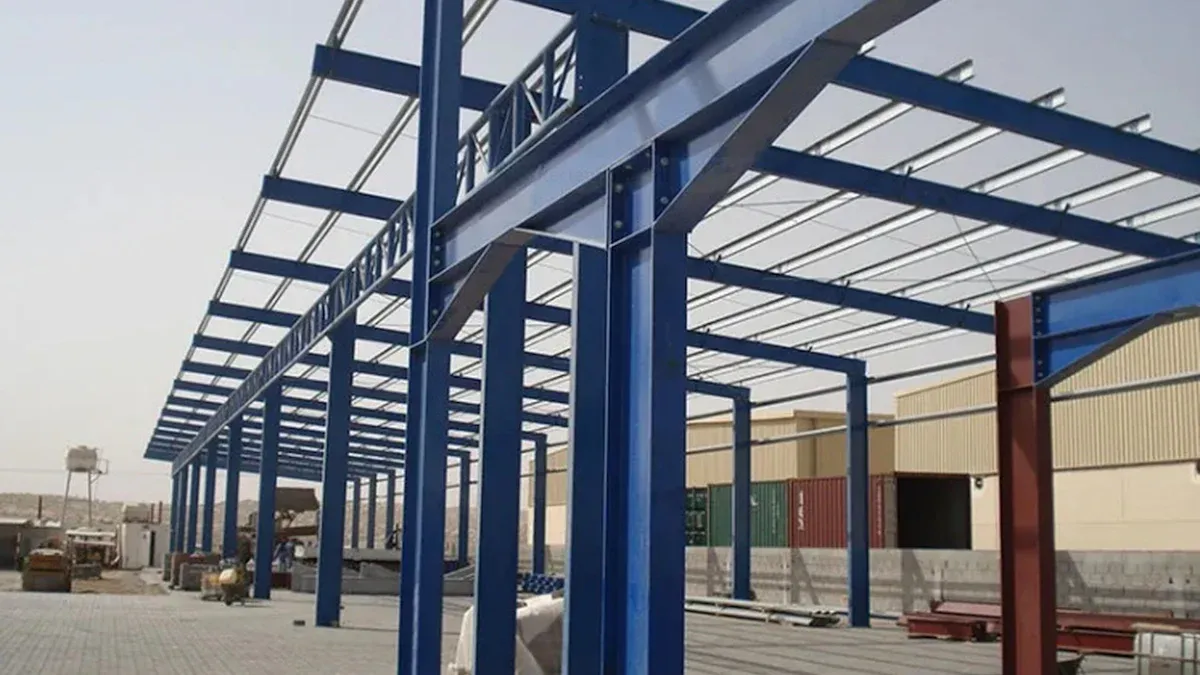
Steel trusses lead when your project demands high strength and long spans. Steel carries heavy loads over spans from 10 to over 200 meters without intermediate supports, and that range frees your interior layout from columns. The material performs near-equally in tension and compression, so you can tune truss geometry to the load pattern. Steel also suits industrial plants, commercial roofs, and long-span structures where durability and dimensional stability matter. When you weigh aluminum truss vs steel truss for a heavy-load application, steel usually wins on raw capacity.
Code and Fire Considerations
Fire resistance drives steel design more than any other code factor. The International Building Code sets structural frame ratings by construction type, and your trusses must meet the rating for your building.
| Construction Type | Structural Frame (incl. trusses) Fire-Resistance Rating |
| Type I-A | 3 hours |
| Type I-B | 2 hours |
| Type II-A | 1 hour |
| Type II-B | 0 hours (no rating required) |
| Type III-A | 1 hour |
| Type III-B | 0 hours |
| Type IV (HT) | Heavy Timber (no hourly SFRM rating) |
| Type V-A | 1 hour |
| Type V-B | 0 hours |
Two provisions can ease the burden:
· Roof-support reduction: frame members supporting only a roof may drop one hour (3h→2h in Type I-A; 2h→1h in Type I-B).
· 20-foot roof height exemption: fire protection of roof framing is not required where every part of the roof sits at least 20 feet above the floor below.
The 20-foot exemption does not apply to Group F-1, H, M, or S-1 occupancies.
You reach the right rating through three steps. First, classify the occupancy under IBC Chapter 3. Second, check height and area limits in Chapter 5. Third, apply Table 601 to the resulting construction type. A warehouse inside Type II-B limits needs no frame rating; the same footprint beyond those limits upgrades to Type II-A and triggers one-hour fireproofing on primary steel. GF-Truss documents the coating or encasement method on every steel submittal.
Cost Profile
Steel carries a higher raw material price than wood. Longer spans, fewer supports, and more usable floor area often offset that premium. Fireproofing adds cost in rated construction, so confirm the required rating early. GF-Truss prices steel against your full scope, including connectors and protection, so you compare installed cost rather than sticker price.
Wood Trusses: Strengths and Best Uses
Where Wood Performs Best
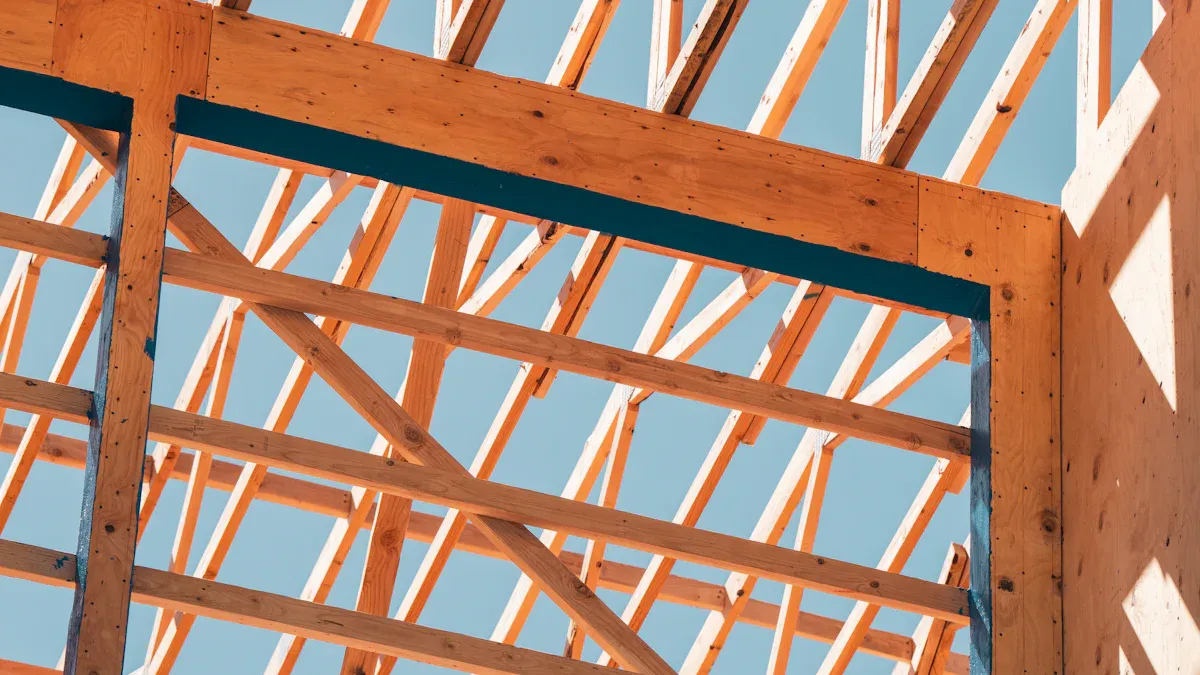
Wood trusses lead in residential roof and floor systems, where engineered timber delivers predictable performance at familiar spans. Different truss profiles cover a wide span range, so you can match the geometry to your floor plan.
| Truss Type | Maximum Span |
| Flat truss | up to 6 m |
| King post truss | up to 8–10 m |
| Queen post truss | up to 12 m |
| Gable truss | up to 15 m |
| Fink truss | up to 25–30 m |
| Attic truss | up to 30 m |
| Mono roof truss | up to 35 m |
| Hip truss | up to 45 m |
| Scissor truss | up to 12–50 m |
These maximums vary with truss design, materials, and local building codes. Floor applications follow a simple rule of thumb: truss height equals the span minus 8, measured in feet. A 32-foot clear span therefore calls for a floor truss roughly 24 inches deep. GF-Truss fabricates wood trusses to your exact span and profile.
Code and Fire Considerations
Wood trusses must satisfy the same IBC fire-resistance ratings as steel, and heavy timber construction offers a recognized path in Type IV buildings. Connector plates need protection that matches your lumber treatment and environment. GF-Truss specifies galvanized or stainless plates per ANSI/TPI 1 and documents every strength reduction on your submittal.
Cost Profile
Wood typically offers the lowest upfront cost for residential work. A basic fink truss runs roughly $3–$5 per board foot, and an attic truss of comparable span costs about double that rate. Wood systems can require more truss sets and more installation steps than steel alternatives, so compare installed totals rather than unit price. GF-Truss quotes wood against your full scope, including connectors and delivery.
Aluminum Trusses: Strengths and Best Uses
Where Aluminum Performs Best
Aluminum trusses lead in stage, event, and lightweight structural systems. You see them in concert and live events, where large-span systems support lighting rigs, LED walls, and audio systems. Exhibition and trade shows rely on flexible aluminum systems for fast setup and creative booth designs. Outdoor events depend on their weather resistance and structural stability. Architectural and temporary structures use aluminum for temporary roofing, walkways, and structural support. Creative and custom structures—curved, circular, multi-layer, and non-standard frameworks—serve high-end concerts, brand launches, and exhibition landmarks.
Span capability depends on truss section size rather than appearance. A 400 mm truss generally provides higher load capacity and longer allowable spans than a 290 mm truss due to its larger section and greater bending resistance. You must base selection on span, loading, support conditions, and engineering calculations—not dimensions alone.
Standard 290 mm or 400 mm aluminum trusses are engineered for point loads from LED walls and line arrays per certified load charts, but for extreme spans such as a 50-meter roof over a stadium, steel truss becomes necessary to prevent excessive sag or deflection.
| Truss Geometry | Typical Use | Key Characteristic |
| Triangular (single-bay) | Lighting bridges, temporary signage | Efficient distribution of compressive and tensile forces |
| Box (square) | Larger spans, overhead structures | Enhanced torsional rigidity |
| Ladder | Decorative runs, narrow spans | Weight savings prioritized |
Code and Corrosion Considerations
Bare aluminum forms a self-healing oxide layer when exposed to oxygen, and 3000 and 6000 series alloys offer good corrosion resistance without protection. Most building codes still require protection due to dissimilar material contact and moisture exposure. Galvanic corrosion is a real risk when aluminum contacts ferrous metals in the presence of conductive fluid. You should avoid high-strength ASTM A490 bolts in contact with aluminum, and select fasteners that match your environment.
| Fastener | Grade/Coating | Corrosion Resistance & Best Use |
| Stainless 304 | Austenitic | Good general resistance; inland exterior and non-marine coastal; moderate cost |
| Stainless 316 | Austenitic + molybdenum | Marine-grade; coastal/high-salt; highest resistance, higher cost |
| Hot-dip galvanized | Thick zinc after fabrication | Very good for many outdoor uses; moderate cost |
ANSI/TPI 1 requires that trusses over an enclosed swimming pool be separated from the pool environment by a vapor barrier and separately ventilated.
Cost Profile
Aluminum costs more per pound than steel in many markets. Its light weight lowers handling and crane costs on projects with tight access. When you weigh aluminum truss vs steel truss, aluminum wins on installation speed and corrosion resistance in coastal settings. GF-Truss quotes aluminum against your full scope, including fasteners and coatings, so you compare installed cost rather than sticker price.
Aluminum Truss vs Steel Truss: Key Differences
Weight and Handling
Aluminum weighs roughly one-third as much as steel for the same section. You can move and position aluminum trusses by hand on many jobs, and that saves crane time and crew strain. Steel demands lifting equipment and careful rigging on most installations. When you compare aluminum truss vs steel truss on a site with tight access, aluminum usually shortens the erection schedule.
Corrosion and Weather Resistance
The two metals fail in different ways. Aluminum oxidizes into a dull gray or white powder that seals the surface. Steel rusts into reddish-brown flakes that weaken the member.
| Feature | Aluminum Truss | Steel Components (Bolts, Pins) |
| Corrosion Type | Oxidation (Aluminum Oxide) | Rust (Iron Oxide) |
| Appearance | Dull gray or white powder | Reddish-brown flakes |
| Effect | Forms a protective layer | Weakens the material |
| Primary Cause | Exposure to air | Exposure to moisture and air |
Aluminum forms a natural oxide layer that resists rust without metallic coatings. Steel needs zinc galvanizing or a zinc-aluminum alloy to delay oxidation. Aluminum holds its integrity longer in salt air, and its oxide layer stays stable even when scratched. Both materials can last 40+ years with proper installation.
Trusses used in rainy, humid, or coastal salt-air environments require much more diligent maintenance. They must be thoroughly cleaned and dried after every single use to prevent rapid corrosion of steel parts and staining of the aluminum. Maintenance routines differ by component. Wipe aluminum tubes clean and dry after every use. Inspect steel bolts and pins for rust before every use, check steel couplers for rust and damage, and replace heavily rusted hardware immediately. Galvanized steel, aluminum alloys, and weather-resistant coatings all maintain structural integrity in high-humidity or coastal industrial settings. Proper surface treatments reduce replacement cycles and maintenance downtime in chemically aggressive atmospheres.
FAQ
Q: Which truss material offers the highest strength?
A: Steel delivers the highest raw strength and the longest spans. It carries heavy loads over 200 meters without intermediate supports. Choose steel for industrial and long-span projects.
Q: Can aluminum trusses replace steel trusses?
A: Aluminum replaces steel in lightweight, corrosion-prone, and temporary applications. Steel remains necessary for extreme spans and heavy loads. Compare both materials against your span and load requirements.
Q: How do you choose the right truss material?
A: Weigh technical performance, application fit, regulatory compliance, and cost against your project. GF-Truss quotes all four materials on the same scope, so you compare options without bias.